

AI Reshaping the Job Market: How Companies and Individuals Should Respond
The wave of artificial intelligence is sweeping across the globe at an unprecedented pace, fundamentally transforming the underlying logic of the job market. According to a McKinsey Global Institute report, by 2030, approximately 400 to 800 million people worldwide may lose their jobs due to automation, but simultaneously AI will create more high-value positions. The World Economic Forum’s “Future of Jobs Report” indicates that by 2025, machines will undertake more work currently performed by humans, but this process will result in a net increase of 12 million jobs. This transformation is not a simple transfer of work, but a reconstruction of the entire industrial ecosystem.
The Deep Impact of AI on the Job Market
The accelerating penetration of automation replacement is rewriting the rules of the labor market. Jobs based on clear rules and high repetition are being rapidly taken over by AI. The demand for data entry clerks has declined by 60% over the past five years, telephone customer service positions are being massively replaced by intelligent voice systems, and basic accounting work has sharply decreased due to the proliferation of RPA (Robotic Process Automation). More alarmingly, AI’s capability boundaries continue to expand—from simple text processing to complex legal document review, from basic image recognition to precision medical imaging diagnosis. White-collar jobs once considered “safe” are now also being impacted.
However, this replacement is not evenly distributed. Oxford University research shows that jobs combining physical labor with cognitive abilities are most difficult to automate, such as plumbers and caregivers who need to make judgments in complex environments and perform hands-on operations. Conversely, jobs that process information in structured environments—whether blue-collar or white-collar—face higher risks.
Job enhancement and human-AI collaboration are becoming the new normal. AI is not meant to completely replace humans, but to redefine human work content. Radiologists no longer need to spend vast amounts of time reading films; AI-assisted systems can mark suspicious areas in seconds, allowing doctors to focus on comprehensive judgment of complex cases. Financial analysts are freed from tedious data organization to focus on strategic decision recommendations. Content creators use AI tools to handle drafts, channeling creative energy into deep thinking and emotional resonance. This collaborative model requires professionals to transform from “task executors” to “AI managers,” from “information processors” to “insight providers.”
The explosive growth of emerging positions reveals future opportunities. AI ethics reviewers, machine learning operations engineers, conversation designers, prompt engineers—these professions that didn’t exist five years ago are now highly sought after in the talent market. More importantly, demand for interdisciplinary talent is surging. Medical data scientists who understand both medicine and AI can earn annual salaries of $500,000; quantitative analysts who understand both finance and algorithms have become core assets of investment institutions. Their market value far exceeds single-domain experts because they can bridge AI technology and industry needs.
The Automation Industry: Leap from Execution to Intelligence
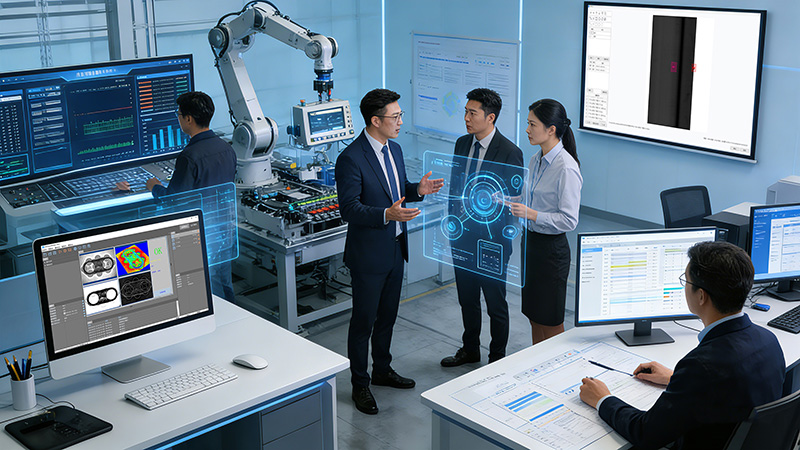
The automation industry itself is undergoing the most dramatic transformation. Traditional industrial automation focused on programming and maintaining hardware equipment like robotic arms and PLCs, while AI integration has made “intelligent automation” mainstream.
Fundamental reorganization of job structures has already begun. Demand for basic PLC programmers is declining because AI can automatically optimize control logic by learning from historical data. But simultaneously, new positions like machine vision engineers, predictive maintenance specialists, and adaptive control system architects are emerging in large numbers. Previously, an automation project required 10 technicians to debug on-site for weeks; now, 3 senior engineers using AI simulation platforms may complete 80% of the work in the office.
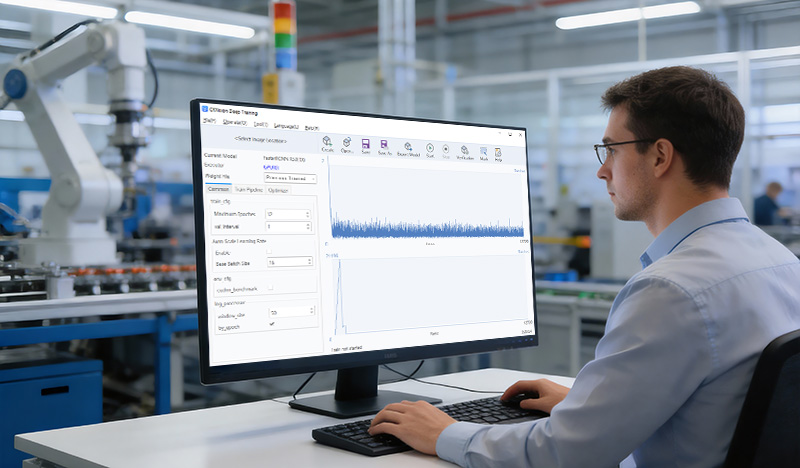
Germany’s Siemens requires its automation engineers to complete AI basic certification, with courses including machine learning introduction, industrial data analysis, and predictive maintenance algorithms. Japan’s FANUC provides six-month “AI+Robotics” intensive training for employees. Practitioners must understand basic machine learning principles, use deep learning frameworks, train defect detection models, and possess systems thinking—how to integrate sensor data, production management systems, and AI algorithms into intelligent manufacturing ecosystems.
Innovation in service models opens new opportunities. Automation companies no longer just sell equipment but provide “Automation as a Service.” Through AI continuously optimizing production parameters, remotely monitoring equipment health status, and predictively allocating spare parts, this subscription service model creates numerous new positions: data analysts, customer success managers, algorithm optimization engineers, and remote operations specialists. Schneider Electric’s “EcoStruxure” platform and Rockwell’s “FactoryTalk” suite are advancing in this direction, with related positions growing at over 30% annually.
Machine Vision Industry: Revolution from Detection to Cognition
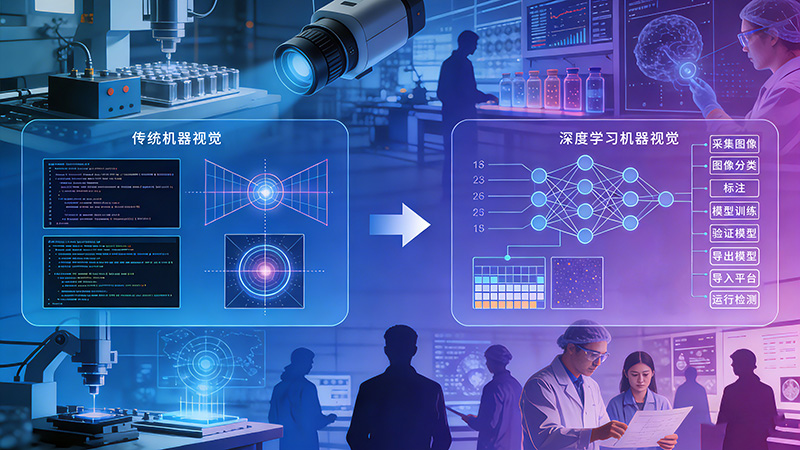
The machine vision industry is one of the areas most directly impacted by AI. Traditional machine vision relied on rules and template matching, while the introduction of deep learning has upgraded machine vision from “seeing” to “understanding.”
Revolutionary transformation of technical paradigm is reshaping the entire industry. Traditional machine vision engineers’ core skills were image processing algorithms and optical design, with project implementation heavily dependent on engineer experience. Deep learning has changed the game—engineers no longer need to manually design feature extraction algorithms but let neural networks automatically learn from large amounts of labeled data. For defect detection, one only needs to collect normal and defective samples, train a model, and achieve accuracy rates that meet or exceed traditional methods.
This brings fundamental changes to skill requirements. Practitioners must master deep learning frameworks, understand convolutional neural networks, object detection, and semantic segmentation model architectures, know how to collect and label high-quality training data, and how to deploy models to edge devices and optimize inference speed.
Job differentiation and emergence of new functions are highly significant. The traditional “machine vision engineer” is differentiating into multiple specialized directions: AI vision algorithm engineers focus on model development and optimization, with annual salaries often exceeding $70,000; vision application engineers are responsible for implementing algorithms in actual projects; data annotation and management specialists design annotation standards and manage annotation teams; edge deployment engineers deploy models to industrial cameras and embedded devices; 3D vision and robot guidance specialists master point cloud processing, pose estimation, and path planning technologies.
Explosive expansion of application scenarios creates abundant opportunities. Traditional machine vision was mainly used for quality inspection in manufacturing; now application boundaries have greatly expanded: product recognition in smart retail, pest and disease identification in smart agriculture, imaging-assisted diagnosis in medical health, vehicle recognition in smart transportation, and behavior analysis in intelligent security. Each new scenario requires cross-disciplinary talent—professionals who understand both vision technology and industry knowledge.
Traditional Manufacturing: Transformation Through Growing Pains

Traditional manufacturing faces the most severe challenges, but also has the greatest transformation potential. Assembly line workers, quality inspectors, and warehouse managers are being rapidly replaced by robots and AI vision systems, but this doesn’t mean manufacturing will become unmanned.
Intelligent transformation of production frontlines is reshaping worker roles. Foxconn’s “lights-out factories” and Tesla’s Gigafactories are not completely unmanned; rather, workers have transformed from operators to supervisors. They monitor AI system operating status, handle exceptions, perform equipment maintenance, and propose improvements. This requires workers to possess basic data reading abilities, fault diagnosis thinking, and human-machine interaction skills. Many Chinese manufacturing enterprises are launching “digital worker” training programs, teaching traditional workers to use mobile devices to view production dashboards and understand equipment operating parameters.
Value reconstruction of middle management is crucial. When AI can optimize production schedules in real-time, automatically allocate materials, and predict equipment failures, the traditional functions of production supervisors and workshop directors are partially replaced. But their new value lies in: understanding AI decision logic and explaining it to teams, handling emergencies that AI cannot cope with, collecting frontline feedback to optimize algorithms, and coordinating cultural conflicts in human-machine collaboration. Companies need to consciously cultivate “AI translators”—backbone forces who understand both production and technology.
Professional upgrading of supply chain and quality management creates new opportunities. AI can analyze massive supplier data to identify risks, but final business negotiations and relationship maintenance require human emotional intelligence and judgment. Machine vision can detect 99.9% of product defects, but quality standard formulation for new products and root cause analysis of complex quality problems still require professional talent. Traditional manufacturing should redirect labor freed by automation toward these higher-value areas.
Tech Companies: Pioneers Leading the Change
Tech companies are both drivers of the AI wave and among the first deep adopters, making changes in their internal job markets significant indicators.
The paradigm shift in software development has already occurred. AI coding assistants like GitHub Copilot increase junior programmers’ work efficiency by 3-5 times, but also change talent demand structures. Many Silicon Valley tech companies have reduced junior developer hiring, instead seeking full-stack engineers who can master AI tools and possess architectural thinking. Programming itself is shifting from “writing code” to “architecture design + AI collaboration + code review,” requiring developers to have stronger systems thinking and business understanding.
AI empowerment of product and operations changes the game rules. Product managers must understand how to design AI-driven user experiences, while operations personnel need to use AI for precise user segmentation and personalized recommendations. Google requires product managers to master basic machine learning concepts, while Meta provides AI tool training for operations teams. Product managers who don’t understand AI will gradually lose competitiveness.
Rapid rise of emerging functions is most significant. AI security engineers earn over $400,000 annually, model interpretability experts help understand “black box” decisions, and LLM application architects design enterprise application solutions for large language models. More interestingly, positions like “human data annotation quality specialists” exist—they need to understand the impact of annotation on model performance, design efficient annotation processes, and manage crowdsourcing teams.
Systematic Corporate Response Strategies
Facing AI’s impact, companies need systematic strategic deployment to transform technological change into organizational upgrades.
Establishing skill maps and transformation paths is foundational. Companies should inventory all positions, assess which functions will be replaced by AI, which will be enhanced, and which will remain stable. Design transformation paths for affected employees—assembly line workers can be trained as equipment maintenance personnel, customer service representatives can transition to customer experience designers. Amazon’s “Career Choice” program subsidizes employees learning high-demand skills, while AT&T invested $1 billion to help 100,000 employees complete job transitions.
Building a continuous learning organizational culture is more critical. Establish learning credit systems, incorporate skill enhancement into performance evaluations; build internal knowledge-sharing platforms encouraging employees to exchange AI application experiences; partner with universities and online education platforms to provide customized courses. Siemens’ “Digital Academy” trains over 100,000 employees annually, while GE’s “Digital Factory Training Center” adopts a “theory + practice” model.
Restructuring organizational architecture and collaboration processes is imperative. Break down departmental barriers to form cross-functional “human-AI collaboration teams”; establish a Chief AI Officer to coordinate AI strategy and talent planning; create “AI labs” allowing employees to freely explore technology application scenarios; adjust incentive mechanisms to reward teams that successfully use AI to improve efficiency.
Individual’s Proactive Evolution Path
In the AI era, individuals must become CEOs of their own careers, proactively planning, continuously investing, and flexibly adjusting.
Identifying and strengthening irreplaceable core capabilities is fundamental. Critical thinking enables you to question AI outputs, creativity allows you to propose solutions AI cannot imagine, empathy enables you to handle interpersonal conflicts AI cannot manage, and ethical judgment allows you to oversee AI decisions. Specific training methods: ask “why” rather than just accepting “what is,” cultivate hobbies to spark creativity, participate in team collaboration to improve emotional intelligence, and contemplate ethical dilemmas to develop value judgment.
Mastering AI tools as basic skills is now consensus. Regardless of your profession, you should be familiar with mainstream AI tools like ChatGPT and Midjourney, understanding their capability boundaries. More importantly, develop “prompt engineering” thinking—how to clearly express needs, how to iteratively optimize results, how to verify AI output accuracy. Take online courses, join AI application communities, and deliberately practice in actual work.
Building T-shaped knowledge structures enhances adaptability. While deepening expertise in your specialty, expand knowledge in related fields horizontally. Finance personnel learn data analysis and business understanding, engineers supplement product thinking and user experience, marketing personnel master data-driven decision methods. This composite capability allows you to play greater value in AI collaboration—you can understand AI suggestions and make judgments based on business reality.
Cultivating personal brand and social capital highlights uniqueness. In an era when AI can mass-produce standardized content, your unique experience, industry insights, and interpersonal networks become more valuable. Continuously output professional perspectives to build thought leadership; deeply participate in industry communities to accumulate trust relationships; create a personal IP so opportunities find you. Remember: AI can replace skills but cannot replicate your life experience and personal charisma.
Maintaining a lifelong learning mindset is the underlying logic. Set yourself a “learning quota”—master at least one new skill annually, deeply understand one new field quarterly, read industry frontier reports monthly, and invest 5-10 hours in learning weekly. Also cultivate “meta-learning ability”—learn how to learn quickly, how to extract lessons from failures, how to transform knowledge into action. Building learning habits is more important than one-time intensive efforts.
Embracing Change, Co-Creating the Future
AI’s impact on the job market is profound and complex. The automation industry is moving from execution to intelligence, machine vision is leaping from detection to cognition, traditional manufacturing is upgrading through growing pains, and tech companies are both driving change and absorbing its impact. Different industries and positions face different fates, but common trends exist: repetitive work is being replaced, complex judgment and creative work are being enhanced, and emerging professions are proliferating.
History repeatedly proves that technological progress creates more opportunities in the long run, improving productivity and living standards. The AI revolution is no different—the key lies in the adaptation speed of individuals and organizations. Companies need strategic vision, cultural transformation, and systematic investment; individuals need proactive learning, embracing change, and continuous evolution.
Future winners won’t be those who resist AI, but those who can dance with AI and leverage technology for advancement. Start acting now: this week, try using an AI tool to solve a real problem; this month, complete an AI application course; this quarter, plan your skill enhancement path; this year, master at least one core capability.
The curtain on AI reshaping the job market has risen, and this transformation has just begun. The best time to respond is now, and the best strategy is action. Let us work together to create a bright future in the AI era, finding our place in the transformation and writing exciting new chapters in our careers.