

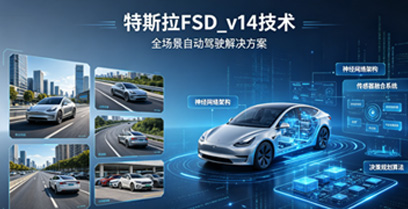
This paper systematically analyzes the technical architecture, development workflow and real-world performance of Tesla Full Self-Driving (FSD) Version 14. FSD v14 marks Tesla’s full transition from traditional modular frameworks to end-to-end neural network solutions supported by an advanced pure vision perception stack. Empirical data shows its critical disengagement mileage has increased more than 20 times from 441 miles in FSD v13 to over 9,200 miles, demonstrating the enormous potential of the end-to-end learning paradigm. This paper conducts an in-depth study on the system’s neural network architecture, training methodology, vision sensor technology and performance under complex scenarios, and verifies the feasibility of this technical route via mathematical models and practical test data.
1 Introduction
The evolution of autonomous driving has witnessed a paradigm shift from rule-based programming to data-driven deep learning. Launched by Tesla in 2024, FSD v14 stands as a landmark milestone of this transformation. Unlike conventional autonomous driving systems split into independent perception, prediction, planning and control modules, end-to-end neural networks directly map sensor inputs to control outputs, greatly reducing system complexity and boosting overall performance.
In its pioneering 2016 paper End to End Learning for Self-Driving Cars, Bojarski et al. first proved that Convolutional Neural Networks (CNN) can derive steering commands straight from raw pixel data. The research adopted a 9-layer network with around 27 million connections and 250,000 parameters. After training on 72 hours of driving footage, the network achieved a 98% autonomy rate in simulation tests.
2 System Architecture & Technical Principles
2.1 End-to-End Neural Network Architecture
The core concept of end-to-end learning is to learn the mapping from perception to control via a single neural network, which can be expressed mathematically as:
a = f(I; θ)
Where I stands for input images, θ represents network parameters, and a refers to output control actions including steering angle and acceleration. Different from modular pipelines that optimize intermediate representations, end-to-end models directly optimize final driving performance.
Tesla FSD v14 adopts the HydraNet, a multi-task learning network capable of processing roughly 50 distinct driving tasks simultaneously. Its core advantage lies in shared feature extraction layers that drastically cut computing overhead. The multi-task weighted loss function of the network is defined as:
L(θ) = Σᵢ wᵢLᵢ(yᵢ, ŷᵢ(θ))
Where Lᵢ is the loss function of the i-th task, wᵢ denotes the task weight, yᵢ stands for ground truth labels, and ŷᵢ represents network prediction results.
2.2 Pure Vision Perception System
Tesla sticks to a pure vision solution equipped with 8 onboard cameras delivering full 360-degree coverage with a maximum detection distance of 250 meters. These cameras adopt customized Sony IMX00N sensors with the following core specifications:
| Technical Parameter | Specification & Performance |
|---|---|
| Resolution | Approximately 5.4 megapixels (2896 × 1876) |
| Pixel Size | 3.0μm (improves low-light sensitivity) |
| Dynamic Range (HDR) | 120 dB; native 12-bit, up to 20-bit in HDR mode |
| Processing Capacity | FSD on-chip ISP: 1 billion pixels per second, supporting tone mapping and noise reduction |
High Dynamic Range (HDR) imaging is critical for handling extreme lighting conditions. Dynamic range is defined as the ratio of maximum detectable light intensity to minimum detectable light intensity, calculated by the formula:
DR = 20 log₁₀(Iₘₐₓ / Iₘᵢₙ) dB
The 120 dB dynamic range of Tesla’s cameras far exceeds the static contrast of human eyes (around 40 dB), enabling simultaneous capture of bright sky and dark tunnel details within a single frame. Studies by Abdullah-Al-Wadud et al. (2018) verified that HDR imaging greatly improves lane detection performance under direct sunlight, and the Mertens exposure fusion algorithm delivers optimal balance of road contrast and color reproduction.
2.3 Direct Photon Counting Technology
Disclosed during Tesla’s Q1 2025 earnings call, the Direct Photon Counting technology adopted by FSD bypasses traditional Image Signal Processors (ISP) and reads raw photon count data straight from sensors. This groundbreaking approach eliminates information loss and noise amplification caused by ISP post-processing.
Conventional cameras rely on ISP for exposure synthesis and brightness compression, which leads washed-out visuals and higher noise under intense sunlight. In contrast, Direct Photon Counting enables neural networks to process near-human or even super-human dynamic range with single-photon level sensitivity, supporting three key capabilities:
- Stable driving under direct sunlight
- Clear visual perception in extremely dark environments
- Fog visibility matching or surpassing human vision
3 Training Infrastructure & Data Pipeline
3.1 Dojo Supercomputer Cluster
Training for FSD v14 is powered by Tesla self-developed Dojo supercomputer, specially optimized for massive video dataset training. Equipped with custom D1 chips and training platforms, Dojo efficiently processes driving footage collected from millions of vehicles across the fleet.
The training process of end-to-end learning is formulated as a supervised learning problem with the objective of minimizing gaps between predicted control signals and human driving actions:
θ* = argmin E₍ᵢ,ₐ₎~D [‖f(I; θ) – a‖²]
Where D represents the distribution of driving data collected from fleets, and (I, a) refers to image-action pairs. To address long-tail data distribution, Tesla applies data augmentation and edge case mining strategies focusing on complex scenarios:
- Complex intersections and unprotected left turns
- Road construction zones and temporary traffic signs
- Severe weather with limited visibility
- Pedestrian and two-wheeler traffic interaction
4 Performance Evaluation & Empirical Analysis
4.1 Critical Disengagement Mileage
According to statistics from the FSD Community Tracker, FSD v14.1 achieved a historic breakthrough in critical disengagement mileage:
| Version | Critical Disengagement Mileage | Performance Multiplier |
|---|---|---|
| FSD v13 | 441 miles | Baseline |
| FSD v14.1 | Over 9,200 miles | 20.9x |
| FSD v14 (Early Test) | 1,454 miles | 3.3x |
This performance jump marks the largest single upgrade after four years of data collection. The test dataset covers 5,149 miles of mixed urban and highway driving across 579 trips recorded from October 7 to November 1, 2024.
Analysis from Piper Sandler analyst Alexander Potter based on Austin Robotaxi fleets shows only 7 NHTSA-classified accidents over 280,000 driving miles, equivalent to one collision per 40,000 miles. Based on an annual driving mileage of 13,000 miles, vehicles with FSD can theoretically operate accident-free for three consecutive years, providing solid empirical evidence for the reliability of the end-to-end technical route.
4.2 Autonomy Rate Calculation
NVIDIA’s landmark research defined the autonomy rate calculation formula, assuming each human takeover takes 6 seconds including intervention, correction and resumption of autonomous driving:
Autonomy Rate = 1 – (Number of Interventions × 6 Seconds) / Total Test Duration (Seconds)
For a 200-kilometer test (approximately 124 miles) at an average speed of 60 km/h with 2 disengagement events, the total test duration is 12,000 seconds:
Autonomy Rate = 1 – (2 × 6) / 12000 = 99.9%
This result outperforms the 98% autonomy rate of NVIDIA PilotNet under controlled lab environments, while FSD v14 operates in far more complex real urban traffic conditions.
5 Image Processing & Environmental Adaptation
5.1 Multi-Frame Fusion & Noise Reduction
FSD adopts multi-frame fusion to enhance image quality in low-light scenarios. Assuming Gaussian noise of independent and identical distribution across N consecutive frames with standard deviation σ, the signal-to-noise ratio (SNR) gain after fusion is calculated as:
SNR Improvement = 10 log₁₀(N) dB
For example, fusing 4 frames delivers a 6 dB SNR boost and greatly stabilizes obstacle detection performance at night.
5.2 HDR Tone Mapping
To compress the 120 dB wide dynamic range for neural network processing, the ISP integrated in FSD chips adopts tone mapping algorithms. The classic Reinhard global tone mapping function is written as:
L_d(x,y) = L_w(x,y) / (1 + L_w(x,y))
Where L_w denotes original scene luminance and L_d represents mapped display luminance. However, Tesla’s Direct Photon Counting skips this traditional compression pipeline, allowing neural networks to process raw high-dynamic-range data without visual information loss.
5.3 Severe Weather Image Restoration
Image degradation in foggy conditions can be modeled with the atmospheric scattering formula:
I(x) = J(x)t(x) + A(1 – t(x))
Where I stands for captured foggy image, J denotes clear scene radiance, A represents atmospheric light, and t is transmittance. FSD’s rain and fog removal algorithms leverage deep learning to fit all parameters and restore clear scene visuals. Neural networks trained on massive rain/fog datasets extract stable target features and compensate single-frame quality loss via sequential frame information.
6 Theoretical Basis & Related Research
6.1 Theoretical Advantages of End-to-End Learning
The core strength of end-to-end pipelines lies in global joint optimization. As analyzed by Chen et al. (2024) in End-to-end Autonomous Driving: Challenges and Frontiers, modular systems suffer error propagation across individual modules. If the perception error is ε₁, prediction error ε₂ and planning error ε₃ for traditional split architectures, the overall error constraint is:
E_total ≥ ε₁ + ε₂ + ε₃
End-to-end models optimize the final driving objective globally with a lower theoretical error ceiling. Bojarski et al.’s research also verified that end-to-end CNNs can realize autonomous navigation on roads with or without lane lines, highways and parking lots with minimal human driving data.
6.2 Comparison of Network Architectures
Academic studies published in the journal Sensors (2019) reveal significant gaps in complexity among mainstream end-to-end autonomous driving networks:
| Network Architecture | Parameter Count | Positioning |
|---|---|---|
| NVIDIA PilotNet | ~250,000 | Lightweight onboard model |
| Modified AlexNet | ~60 Million | Server-side training |
| J-Net | ~240,000 | Embedded low-computing devices |
| Tesla HydraNet | Over 100 Million | Multi-task large model for FSD chip |
HydraNet shares feature extraction layers to balance high performance and computing efficiency, enabling real-time 30 FPS inference on Tesla’s onboard FSD hardware.
7 Challenges & Limitations
7.1 Extreme Scenario Generalization
Despite massive performance gains, FSD v14 still faces limitations in rare edge cases. In October 2024, NHTSA launched an official investigation covering 2.4 million Tesla vehicles equipped with FSD, focusing on system performance under low light and low visibility conditions.
The generalization capacity of neural networks heavily relies on training data coverage. Scenarios with insufficient sample records such as rare road layouts and extreme weather yield unstable detection results, an inherent drawback of end-to-end learning that requires continuous data accumulation and model iteration.
7.2 Hardware Version Restrictions
Full FSD v14 functions are only available on HW4 (AI4) hardware platforms, while vehicles equipped with HW3 remain limited to FSD v12. The gap stems from differences in computing power to support complex neural networks. Community feedback indicates distinct performance disparities across hardware variants, and Cybertruck requires exclusive model tuning due to its unique sensor layout and wheelbase.
7.3 Regulation & Standardization
FSD is still classified as Level 2+ ADAS requiring constant driver supervision. To achieve Level 4 or Level 5 driverless autonomy, the system must satisfy strict safety certification and hardware redundancy standards. The pure vision architecture without LiDAR hardware redundancy may become a bottleneck for higher autonomy grades.
8 Future Development Directions
8.1 Foundation Model Pre-Training
The integration of large language and vision foundation models into end-to-end autonomous pipelines has become a key research trend. Pre-trained vision encoders deliver stronger feature extraction capabilities and reduce reliance on task-specific labeled data. The high-resolution neural vision encoder introduced in FSD v14.2 greatly improves recognition of emergency vehicles, road obstacles and human hand gestures.
8.2 World Model Construction
Building accurate World Models is critical for fully autonomous driving. World Models predict future environmental states to support long-term planning and decision-making. Combined with NeRF and 3D Gaussian Splatting technology, systems can learn implicit geometric and visual representations from video footage for precise scene modeling and simulation.
8.3 Causal Reasoning & Interpretability
The black-box nature of end-to-end networks undermines transparency and credibility. Future research will balance performance with causal reasoning to resolve causal confusion where models learn spurious correlations instead of real physical logic. Visual attention visualization and explicit causal inference modules will be introduced to boost system safety and traceability.
9 Conclusion
Tesla FSD v14 represents a landmark breakthrough for end-to-end autonomous driving technology. Adopting HydraNet multi-task neural networks, pure vision sensors with Direct Photon Counting and the Dojo training cluster, FSD v14 delivers a more than 20x leap in critical disengagement mileage. As validated via theoretical derivation and real-world data, end-to-end learning eliminates error accumulation across split modules, while the pure vision stack with 120 dB HDR and photon counting delivers super-human perception under diverse lighting and weather conditions. The Dojo supercomputer supports training on massive real-world driving footage to handle complex road scenarios.
Nevertheless, FSD v14 still faces three core constraints: insufficient generalization for extreme edge cases, hardware version fragmentation and regulatory classification barriers. Future iterations will integrate vision foundation models, 3D world modeling and causal interpretable algorithms for continuous upgrades.
Tesla’s controversial LiDAR-free pure vision technical route follows clear core logic: humans drive safely relying solely on visual perception, and neural network-powered onboard vision systems can theoretically match or exceed human driving safety. Massive real-world mileage data from FSD v14 proves this vision is gradually being realized, yet long-term technological innovation and large-scale field verification are still required to reach human-level reliability.
References
References
- Bojarski, M., Del Testa, D., Dworakowski, D., Firner, B., Flepp, B., Goyal, P., … & Zhang, X. (2016). End to end learning for self-driving cars. arXiv preprint arXiv:1604.07316.
- Chen, L., Wu, P., Chitta, K., Jaeger, B., Geiger, A., & Li, H. (2024). End-to-end autonomous driving: Challenges and frontiers. IEEE Transactions on Pattern Analysis and Machine Intelligence.
- Kocić, J., Jovičić, N., & Drndarević, V. (2019). An end-to-end deep neural network for autonomous driving designed for embedded automotive platforms. Sensors, 19(9), 2064.
- Abdullah-Al-Wadud, M., Kabir, M. H., Dewan, M. A. A., & Chae, O. (2018). Application of HDR algorithms to solve direct sunlight problems when autonomous vehicles using machine vision systems are driving into sun. Journal of the Optical Society of Korea, 22(1), 6-14.
- Chib, P. S., & Ahuja, B. (2023). Recent advancements in end-to-end autonomous driving using deep learning: A survey. arXiv preprint arXiv:2307.04370.
- Tesla, Inc. (2025). Q1 2025 Earnings Call Transcript. Retrieved from Tesla Investor Relations.
- FSD Community Tracker. (2025). Full Self-Driving Performance Metrics. Retrieved from community tracking database, November 2025.
- Potter, A. (2025). Tesla FSD analysis: Approaching unsupervised autonomy. Piper Sandler Research Report, December 2025.
- National Highway Traffic Safety Administration (NHTSA). (2024). Investigation into Tesla Full Self-Driving System, ODI Resume PE 24-021.
- Tesla FSD Chip Technical Specifications. Retrieved from https://en.wikichip.org/wiki/tesla_(car_company)/fsd_chip.