


Difficulties and Breakthrough Paths of China’s Machine Vision Industry
In-depth Research Report | 2025
Table of Contents
- Industrial Overview: From Follower to Competitor
- Core Bottlenecks: Five Dimensions of Core Technology Restrictions
- Competitive Landscape: Comparison of Domestic & Overseas Leading Players
- Breakthrough Strategy: Tiered Collaboration Framework
- Fundamental Algorithms: The Most Critical Yet Overlooked Battlefield
- Opportunity Window: Strategic Judgement for the Next Five Years
- Conclusion: From a Large Industry to a Powerful Industry
1 Industrial Overview: From Follower to Competitor
China’s machine vision industry has achieved explosive growth over the past 15 years. In the early stage, the sector relied almost entirely on imported equipment and algorithms. Today, a number of competitive domestic enterprises including Hikrobot, Opt Machine Vision, TZTEK and CKVISION have emerged, pushing China’s domestic market scale to the forefront globally.
Nevertheless, a massive gap still lies between “large scale” and “industrial strength”. The prosperity of China’s machine vision sector is largely driven by the scale dividend of manufacturing and the expansion of system integrators, rather than genuine breakthroughs in fundamental technologies. Distinguishing between the two is a prerequisite for formulating sound development strategies.
1.1 Market Scale & Industrial Chain Structure
China’s machine vision industrial chain currently features a typical dumbbell-shaped structure: core components and high-end algorithms are dominated by foreign manufacturers, while a large number of domestic enterprises compete fiercely in the middle system integration segment. This structure leads to widespread thin profit margins and weak moats for domestic players.
| Industrial Chain Link | International Representative Enterprises | Domestic Representative Enterprises | Localization Rate |
|---|---|---|---|
| Image Sensors | Sony, onsemi | OmniVision, GalaxyCore | ~15% (Industrial Grade) |
| Optical Lenses | Fujinon, Schneider | United Optics, Forecam Optics | ~30% |
| Image Frame Grabbers | Matrox, Euresys | Huaray Vision, CKVISION | ~40% |
| Vision Algorithm Platforms | MVTec (Halcon), Cognex | CKVISION (CKVision) | ~20% |
| System Integration | Keyence, Cognex | Mass domestic integrators | Over 70% |
The table reveals an alarming fact: the closer a link is to underlying technologies, the lower its localization rate. The booming system integration market masks severe shortages in upstream core technologies, the root cause of the industry’s “bloated yet hollow” status.
1.2 Growth Drivers
Three core forces fuel industrial expansion:
- Domestic demand driven by intelligent manufacturing transformation;
- Demand for high-precision inspection brought by booming semiconductor and lithium battery sectors;
- Disruptive substitution of traditional rule-based algorithms by AI deep learning.
The overlapping of these forces has created a historic market window.
Semiconductor and lithium battery industries deserve special attention. Wafer defect inspection and pole piece coating inspection impose extreme requirements on resolution, speed and algorithm precision, forcing leading domestic vision enterprises to step out of their comfort zones — a rare incentive for technological upgrading.
2 Core Bottlenecks: Five Dimensions of Core Technology Restrictions
China’s machine vision industry faces systematic deficiencies spanning materials, components, algorithms and ecosystems, rather than isolated single-point issues.
2.1 Sensors: Critical Deficiencies in Industrial CMOS
Image sensors serve as the “retina” of machine vision and rank among the least localized core components. Industrial CMOS sensors demand far higher quantum efficiency, dynamic range and noise control than consumer-grade counterparts — precisely the weakest areas for domestic manufacturers.
While OmniVision and GalaxyCore have made breakthroughs in consumer camera sensors, industrial products present distinct challenges. Industrial cameras require larger pixel sizes for higher sensitivity, faster frame rates, wider dynamic ranges and long-term stability under extreme temperature and humidity. Sony’s IMX series dominates the market thanks to decades of manufacturing accumulation, which cannot be caught up by short-term capital investment alone.
Deeper underlying challenges lie in EDA tools and wafer fabrication. High-end image sensors require tape-out at TSMC, Samsung and other advanced fabs. Rising geopolitical risks amplify vulnerabilities in this link.
2.2 Algorithm Platforms: Hidden “Software Core Restrictions”
Dependence on software platforms is more covert yet riskier than hardware reliance. The vast majority of domestic system integrators build their vision systems on Germany’s MVTec Halcon or the US-based Cognex VisionPro. After 30–40 iterations, these two platforms feature hundreds of industrially validated underlying algorithms, including morphology, subpixel measurement, 3D point cloud processing and calibration.
Domestic secondary development on Halcon is equivalent to building on others’ foundations. This brings not only intellectual property risks, but also a risk of total system collapse in the event of technical blockades.
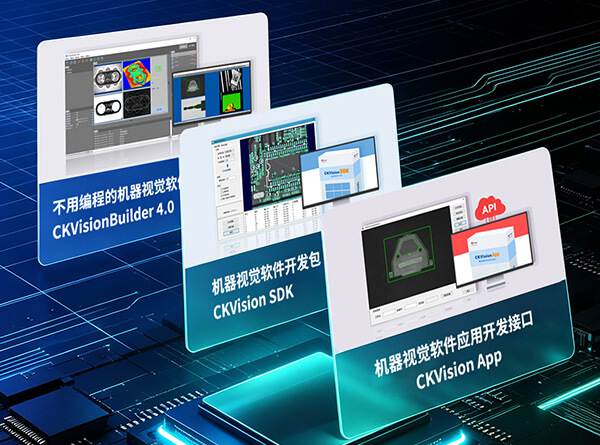
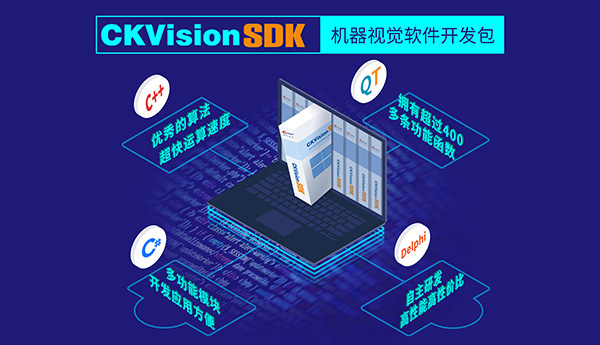
Very few domestic enterprises have the capacity to independently develop underlying algorithm platforms. CKVISION is one of the rare players that sticks to self-developed underlying algorithms, represented by its CKVisionBuilder and CKVisionSDK platforms. However, CKVISION still lags behind Halcon in ecosystem maturity and requires further advancement.
2.3 Optical Systems: Underestimated Precision Manufacturing Shortcomings
High-end industrial lenses represent a severely underestimated technical barrier. Precision lens grinding, coating and assembly involve deep cross-disciplinary integration of material science, precision machinery and optical design. Fujinon, Schneider and Nikon boast decades of accumulated expertise in this field.
For semiconductor inspection and high-precision measurement, lens distortion control, chromatic aberration correction and MTF curves directly determine the upper limit of vision system performance. Domestic lenses are competitive in mid-to-low-end scenarios, while international brands maintain absolute dominance for industrial cameras above 50MP.
2.4 Paid Ecosystem: Structural Lack of IP Awareness
An often overlooked yet critical bottleneck is the weak culture of commercial software licensing in China, which severely undermines the viability of fundamental algorithm developers.
Halcon’s official licensing fees in China are substantial, yet numerous integrators opt for cracked versions instead of domestic alternatives. This creates a vicious cycle: domestic algorithm firms lack sufficient revenue to support R&D, resulting in slow product iteration and eroded market trust. Cognex and MVTec sustain continuous iteration partly due to robust IP protection and mature paid software markets in Europe and North America.
2.5 Talent: Severe Shortage of Interdisciplinary Engineers
Core machine vision technologies require cross-disciplinary engineers proficient in optical engineering, computer vision algorithms, embedded systems and industrial automation. Such talents require over ten years of training, while university curricula in China are drastically misaligned with industrial demands.
Top algorithm researchers mostly shift to internet AI sectors for higher salaries or pursue overseas studies; optical engineering graduates tend to enter consumer electronics rather than industrial vision; system integrators employ a large workforce of engineers who can operate tools yet lack foundational theoretical knowledge. This talent structure blocks the industry’s transition from system integration to original technology creation.
3 Competitive Landscape: Comparison of Domestic & Overseas Leading Players
3.1 Competitive Advantages of International Giants
The moats of Cognex and Keyence extend far beyond superior technical performance.
- Cognex’s core moat: Ecosystem stickiness of VisionPro. Tens of thousands of global vision engineers train on Cognex platforms, with client training systems, operation manuals and internal knowledge bases deeply bound to its software. Migrating to alternative platforms incurs massive retraining costs and systematic risks, forming an intangible lock-in far harder to surmount than patents.
- Keyence’s core moat: Unique business model. Instead of relying on integrators, highly skilled field engineers deliver turnkey solutions directly to end clients. Rooted in Japan’s precision manufacturing culture, continuous product iteration creates strong brand premium and customer loyalty.
3.2 Tiered Classification of Domestic Enterprises
Domestic machine vision enterprises fall into three tiers with distinct competitive logics and ceiling limits:
- Tier 1: Security conglomerates (Hikrobot, Dahua)
Leverage hardware manufacturing and channel strengths to enter the market rapidly, yet rely heavily on third-party core algorithms with limited in-house technical depth.
- Tier 2: Specialized niche manufacturers (Opt Machine Vision, TZTEK)
Deep expertise in vertical tracks such as lithium batteries and semiconductors with strong competitiveness, yet constrained by limited market expansion space due to narrow application coverage.
- Tier 3: Small & medium system integrators
Severely homogenized, competing solely via price wars with nearly zero independent R&D capacity, representing the most fragile business model.
CKVISION stands out as a unique player. Positioned as an algorithm platform developer, it follows a development path similar to MVTec — a nearly unique positioning in China. Nevertheless, it still faces a generational gap in scale and resources compared with international competitors.
4 Breakthrough Strategy: Tiered Collaboration Framework
Industrial strength does not require every enterprise to conduct fundamental R&D. Genuine breakthroughs demand specialized players across all industrial chain links to coordinate joint efforts.
4. National Level: State Intervention for Public-Good Technologies
Fundamental algorithms, sensor materials and EDA tools feature high investment costs, long R&D cycles and strong externalities, which cannot be fully driven by pure market mechanisms. Historically, DARPA funded foundational computer vision research in the US, Fraunhofer Institutes supported MVTec’s early-stage development in Germany, and Japan’s Ministry of International Trade and Industry facilitated Sony’s sensor industrialization.
China still lacks concentrated resource allocation for this field. Current special funds are scattered across low-efficiency projects, without long-term targeted support for strategically vital technologies. A feasible solution is to launch a dedicated machine vision fundamental technology fund modeled after the national semiconductor fund, concentrating resources on 1–2 promising platform/sensor enterprises to support decade-long technological accumulation.
4. Platform Level: China’s Equivalent of “Industrial Vision Android”
Breakthroughs at the platform layer serve as a leverage point for full industrial chain upgrading. A mature domestic industrial vision algorithm platform can liberate tens of thousands of integrators from Halcon reliance, converting accumulated industry data and iterative algorithms into overall industrial competitiveness.
A disruptive open-source strategy merits consideration. Instead of competing head-on with closed commercial libraries like Halcon, learn from Linux vs Windows: build an open-source industrial vision ecosystem to aggregate global developer contributions, offsetting individual resource shortages via ecosystem advantages. OpenCV has proven the power of open-source computer vision, yet no mature open platform exists specifically for industrial scenarios.
Advancing this agenda requires a leading entity with long-term strategic vision — either government research institutes or commercial firms with sufficient capital and foresight to sacrifice short-term gains.
4. Scenario Level: Specialization Outperforms All-Round Development
Most enterprises lacking fundamental R&D capacity should abandon the pursuit of universal technology and become irreplaceable specialists in vertical scenarios.
While algorithms can be licensed from platform vendors, proprietary defect sample libraries, process parameter databases, debugging experience and client trust accumulated within a specific application cannot be replicated by outsiders. A manufacturer specializing in lithium battery tab welding inspection that serves multiple top-tier clients and accumulates massive defect datasets can train dedicated models far more accurate than universal algorithms, forming genuine data moats.
This path creates synergy with platform development: mature domestic algorithm platforms lower algorithm costs for vertical specialists, enabling them to allocate more resources to data accumulation and client services.
4. Consolidation Level: Mergers & Acquisitions to Reshape the Industry
The current fragmented market structure is unsustainable. Mergers and acquisitions driven by capital will accelerate over the next 5–10 years, eventually forming a small group of large-scale enterprises capable of sustaining heavy R&D investment.
Potential reverse M&A logic: Algorithm platform enterprises (e.g. CKVISION) acquire or form deep partnerships with vertical integrators to obtain industrial data for algorithm iteration; alternatively, vertical leading manufacturers acquire algorithm capacity to evolve into full solution providers. Both models are viable, contingent on sufficient strategic vision and capital support.
5 Fundamental Algorithms: The Most Critical Yet Overlooked Battlefield
Fundamental algorithms constitute the industrial chain’s foundation. A weak foundation cannot support high-rise facilities against market shocks.
5.1 Why Fundamental Algorithms Matter
Fundamental algorithms in machine vision refer to core underlying tools forming processing workflows: image filtering & enhancement, morphological operations, edge & contour detection, feature matching, calibration, 3D reconstruction and optical flow analysis.
Though seemingly commonplace, these tools carry immense engineering barriers. Take MVTec Halcon’s template matching as an example: it integrates over a dozen mathematical optimization methods to support subpixel precision, illumination invariance and partial occlusion resistance, validated across hundreds of industrial scenarios. Such engineering refinement cannot be replicated merely by grasping theoretical principles — it requires countless iterations on real production lines.
When all domestic integrators build systems on Halcon, China’s entire machine vision industry is, to some extent, subject to a medium-sized German firm. This represents an extremely fragile industrial security posture.
5.2 Barriers to the Survival of Fundamental Algorithm Vendors
Business Model Barrier
The optimal monetization channel for algorithm libraries is software licensing. However weak domestic IP protection leads widespread adoption of pirated Halcon versions, cutting off domestic algorithm firms’ primary revenue stream. Before a mature paid software culture emerges, algorithm developers can only rely on service fees and customized projects, conflicting with scalable mass-market business models.
Capital Patience Barrier
Fundamental algorithm R&D typically requires over seven years to generate returns, while China’s venture capital ecosystem generally expects exit within 3–5 years. This timeline mismatch forces most algorithm startups to pivot to faster-yield integration services or shut down after exhausting funding.
Talent Density Barrier
To compete head-on with Halcon, a firm requires a team of at least 20+ senior engineers with 10+ years of experience in computer vision, numerical optimization and parallel computing. Such talent pools are scarce in China, let alone concentrated within small startups.
5.3 Feasible Breakthrough Routes
Localization of fundamental algorithms is achievable under combined favorable conditions:
- Targeted national strategic support: Similar to domestic breakthroughs in communications, operating systems and databases, government procurement and policy support provide early real-scene validation and baseline revenue for industrial vision algorithm platforms.
- In-depth industry-university-research collaboration: Top universities including Tsinghua, Shanghai Jiao Tong University and Zhejiang University boast solid foundational computer vision research, yet suffer poor commercialization mechanisms. Establishing effective talent rotation channels converts academic papers into industrialized engineering modules to fill talent gaps.
- Capture AI paradigm shift opportunities: The rise of deep learning partially erodes Halcon’s decades-long accumulated advantage. China’s strengths in algorithm research and industrial data create opportunities to achieve leapfrog development on new-generation AI vision platforms.
6 Opportunity Window: Strategic Judgement for the Next Five Years
6.1 Accelerated Localization Driven by Geopolitics
Escalating US-China tech competition has transformed domestic substitution from an optional choice to a necessity. Strategic industries including semiconductors, aerospace and defense actively seek independent domestic vision solutions, creating historic market entry opportunities for technically accumulated local vendors.
This window will last approximately 3–7 years. Once strategic clients build deep partnerships with domestic suppliers, migration costs will form new competitive moats, granting decisive first-mover advantages.
6.2 Paradigm Disruption by Large Models & Embodied Intelligence
Large Vision-Language Models (VLM) and embodied intelligent robots may fundamentally reshape industrial vision technical architectures within five years. Current rule-based and supervised learning inspection systems could be replaced by general foundation models capable of adapting to new tasks with minimal or zero samples.
This brings both threats and opportunities for Chinese enterprises:
- Threat: Traditional algorithm platforms like Halcon may lose their accumulated technical advantages;
- Opportunity: China’s strengths in large model training and industrial data create potential to take the lead in new-generation industrial vision frameworks.
Seizing this window requires immediate investment: systematically organize industrial vision scene data into training corpora and cooperate with domestic large model teams to pre-empt industrial vision foundation model layout.
6.3 Overseas Expansion: Blue Ocean Markets in Emerging Manufacturing Regions
Manufacturing industries in Southeast Asia, South Asia, the Middle East and Latin America are undertaking global industrial transfer, with factory intelligent demand set to surge. European, American and Japanese giants maintain low market penetration in these regions.
Chinese machine vision enterprises possess natural cost-performance advantages, alongside capabilities for fast-response, customized local services. Local market demands align closely with Chinese factory development stages, delivering superior solution compatibility. Taking Southeast Asia as a starting point and expanding gradually to the Middle East and Latin America offers a viable path to surpass international competitors.
7 Conclusion: From a Large Industry to a Powerful Industry
The dilemmas of China’s machine vision industry mirror the broader challenges of advanced manufacturing nationwide:
- Strength in scaled application, weakness in original technology creation;
- Strength in rapid integration, weakness in long-term foundational accumulation;
- Strength in cost competition, weakness in value system construction.
There are no shortcuts to industrial upgrading. Achieving industrial strength requires specialized enterprises across every critical industrial chain link: sensor developers, algorithm platform vendors, vertical scenario specialists and global expansion teams. This cannot rely solely on market forces, and demands targeted national strategic investment, longer-term capital patience and mature industry-wide IP awareness.
Enterprises like CKVISION that persist in independent underlying algorithm R&D take the hardest yet most valuable path. Such persistence deserves respect amid a market dominated by short-term profit pursuits.
Machine vision serves as the “eyes” of intelligent manufacturing, an indispensable technical infrastructure for China’s manufacturing upgrade. Whether China can achieve genuine breakthroughs in this sector within the next decade hinges on whether enough stakeholders are willing to commit to slow yet transformative long-term work.