

Introduction
In the field of machine vision, matching technology is one of the core technologies for target positioning, recognition, and tracking. From early pattern matching to geometric matching, contour matching, and today’s AI deep learning era, matching algorithms have evolved over decades. This paper systematically reviews the development history of this technology, discusses algorithmic paths for performance optimization, and re‑examines the value of traditional matching methods amid the AI wave.

1、 Development History of Matching Technology
1.1 Origin of Pattern Matching
As the most primitive and basic pattern recognition method, pattern matching locates and identifies specific objects in an image. It was applied to industrial vision inspection starting in the 1970s.
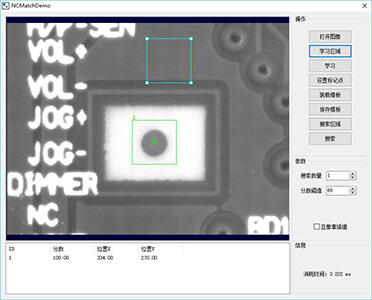
Early pattern matching adopted a gray‑level‑based strategy: it compares the gray matrix of a matching window with all possible window arrays in the template pixel by pixel, using similarity metrics such as Normalized Cross‑Correlation (NCC), Mean Absolute Difference (MAD), and Mean Square Difference (MSD).
However, pattern matching is limited to pure translation and fails if the target rotates or scales. This fundamental flaw drove researchers to explore more robust methods.
1.2 Breakthrough of Geometric Matching
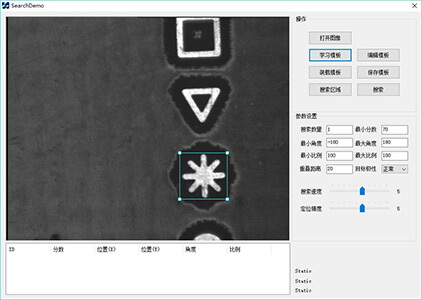
To overcome sensitivity to rotation and scaling, geometric matching emerged. It extracts edges, gradients, and gradient directions (high‑frequency image components) as matching features, achieving strong robustness against lighting changes, deformation, and occlusion.
Its core advantage is reliance on edge gradient direction rather than pixel gray values. This approach is widely used in major commercial vision libraries, such as Halcon’s Shape‑based Matching and Cognex’s PatMax.
PatMax, a representative geometric matching algorithm, builds models from edge geometric features and reliably handles rotation, scaling, and occlusion in industrial inspection.
1.3 Refinement of Contour Matching
Contour matching is an important branch of geometric matching, focusing on object contour extraction. It typically performs edge detection, extracts continuous contours, represents features via shape descriptors (Fourier descriptors, invariant moments, etc.), and then performs matching.
It excels at regular‑shaped, clear‑edged objects and is widely used in component inspection and PCB testing. Compared with full geometric matching, it is faster and lighter but demands higher image quality and edge extraction accuracy.
1.4 Rise of Feature Point Matching
With advances in computer vision, local feature point matching became mainstream.
- 1977: Moravec proposed the “interest point” concept.
- Later: Harris corner detector, SUSAN operator, etc.
- 1999–2004: Scale‑Invariant Feature Transform (SIFT) became a milestone, enabling scale‑ and rotation‑invariant feature extraction.
SIFT and its variants (SURF, ORB) remain stable under scaling, rotation, and lighting changes, greatly expanding matching applications.
2、 Algorithm Strategies for Improving Matching Performance
2.1 Multi‑Scale Feature Extraction
To handle target scaling, multi‑scale feature extraction became critical. SIFT achieves scale invariance via scale‑space construction, a standard strategy adopted by many later algorithms.
2.2 Fast Matching Algorithms
Traditional exhaustive search is computationally heavy. Accelerated methods such as Sequential Similarity Detection Algorithm, two‑level template matching, hierarchical sequential matching, and multi‑subregion correlation matching greatly reduce complexity through hierarchical search, region restriction, and early termination.
The LineMode algorithm (gradient‑direction based) is especially efficient: processing 1M‑pixel images in ~60 ms and matching 360 templates in only 7 ms.
2.3 False Matching Removal
Initial matches often include many outliers. Classic solutions include:
- RANSAC (Random Sample Consensus)
- Local Preserving Matching (LPM)
- Grid‑based Motion Statistics (GMS)
- Hierarchical motion consistency methods
These use geometric constraints to reject false matches.
2.4 Introduction of Deep Learning
In recent years, deep learning has been applied to feature extraction and matching. End‑to‑end matching networks such as HomographyNet and LoFTR learn discriminative features via CNNs and perform well in complex deformation scenarios.
3、Core Roles of Pattern Matching in Industry
3.1 Precise Positioning and Guidance
Pattern matching is foundational for accurate part positioning on automated lines, including robot picking, assembly, laser marking, and welding. Geometric matching is the preferred 2D vision method due to rotation and scaling invariance.
3.2 Quality Inspection and Defect Recognition
It compares real products with standard templates to quickly detect defects, incompleteness, or misassembly, widely used in electronics and automotive component inspection.
3.3 Measurement and Metrology
Matching‑based measurement achieves sub‑pixel accuracy for dimensions, spacing, angles, etc., essential in semiconductor and precision machining.
3.4 OCR and Barcode Recognition
Although deep learning dominates OCR, traditional template matching remains widely used for fixed fonts and standard barcodes due to high speed and low resource usage.
4、 Value of Traditional Matching Technology in the AI Wave
4.1 Comparison Between Deep Learning and Traditional Methods
Traditional methods rely on handcrafted features and become cumbersome as categories increase. Deep learning enables end‑to‑end learning from annotated datasets, automatically discovering discriminative features.
Yet deep learning is not a panacea; many applications still favor traditional computer vision.
4.2 Unique Advantages of Traditional Matching
- Determinism & Interpretability: Based on clear mathematical and geometric models; failures are easily diagnosed (lighting, template, parameters). Deep learning is often a “black box.”
- Low Data Requirements: Works with one standard template, ideal for small‑sample and customized production.
- Low Computational Cost: Runs in real time on standard CPUs without GPUs, suitable for resource‑constrained embedded systems.
- Excellent Real‑Time Performance: Optimized geometric matching (e.g., LineMode) completes tasks in milliseconds, meeting high‑speed line requirements.
- Robustness & Stability: Decades of engineering validation; highly reliable in controlled lighting and regular‑target scenarios. Deep learning may fail unexpectedly on out‑of‑distribution data.
4.3 Application Scenarios in the AI Era
- Industrial Inspection & Manufacturing: Electronics, machining, automotive parts with fixed shapes, controlled lighting, high speed, and low false‑detection tolerance. Geometric matching often exceeds 99.9% accuracy.
- Medical Image Registration: Traditional feature‑point methods (e.g., SIFT) remain important for rigid registration without large training datasets.
- Embedded Vision Systems: Drones, robots, smart cameras benefit from lightweight traditional matching on low‑power processors.
- Frontend for Hybrid Architectures: Use fast template matching for coarse ROI positioning, then deep learning for fine recognition — balancing speed and accuracy.
4.4 Integration Trend of Traditional and AI Technologies
The future is not replacement but deep fusion:
- Use deep learning to enhance traditional algorithms (learn robust descriptors, optimize parameters).
- Embed geometric constraints and prior knowledge into deep models to improve interpretability and generalization.
This synergy has been validated in autonomous driving and industrial inspection.
5 Outlook and Thinking
5.1 Insights from Technological Evolution
Matching has evolved from simple to complex, from handcrafted to learned. Yet simpler methods retain value; choose tools based on application needs.
5.2 Wisdom in Engineering Practice
In industry, “good enough” often beats “cutting edge”. Use simple gray matching if it solves the problem. Engineers must balance performance, cost, development time, and maintainability.
5.3 Technological Philosophy in the AI Era
AI enriches the toolbox rather than eliminating traditional tech. Like mechanical brakes in autonomous vehicles, traditional matching serves as a backup and validator for deep learning in critical industrial applications.
Even modern deep feature extraction often borrows from SIFT, showing that classical principles remain foundational.
Conclusion
From pattern matching to geometric matching, contour matching, and deep learning, machine vision matching has evolved greatly. In the AI era, traditional methods are not obsolete — they excel in determinism, interpretability, low resource usage, and real‑time performance, making them irreplaceable in many industrial scenarios.
Future vision systems will likely integrate traditional and AI technologies, combining deep learning’s learning power with traditional methods’ reliability and efficiency. For engineers, understanding each technology’s principles and suitable scenarios is key to building practical vision systems.
Technology’s value lies not in novelty, but in solving real problems. “Old” techniques like pattern and geometric matching remain vibrant today. Together with AI, they drive the continued advancement and application of machine vision.