

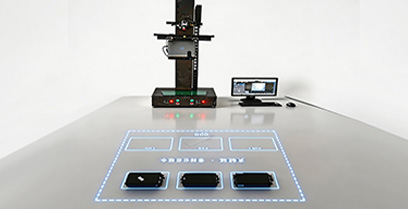
Machine Vision + Spatial Projection
Giving the Assembly Workstation Eyes That Catch Mistakes
1. The Challenge: Manual Assembly in Flexible Production
As consumer electronics, automotive components, and medical devices move toward High-Mix, Low-Volume production, assembly lines face ever more frequent changeovers, a growing variety of workpieces, complex process steps, and long onboarding cycles for new operators. Traditional paper work instructions (SOPs) and offline displays force operators to keep shifting their gaze between “reading the drawing” and “doing the work.” This causes fatigue and makes it hard to eliminate missed parts, wrong parts, wrong picks, and wrong placements. Post-process inspection and sampling can only find defects after the fact; they cannot prevent them.
To address this bottleneck, a guided-work and closed-loop error-proofing system based on machine vision and spatial projection (Projection-based Poka-Yoke) has emerged. Borrowing the spatial-mapping idea from augmented reality (AR), it turns the work surface into an interactive, self-verifying digital work board.
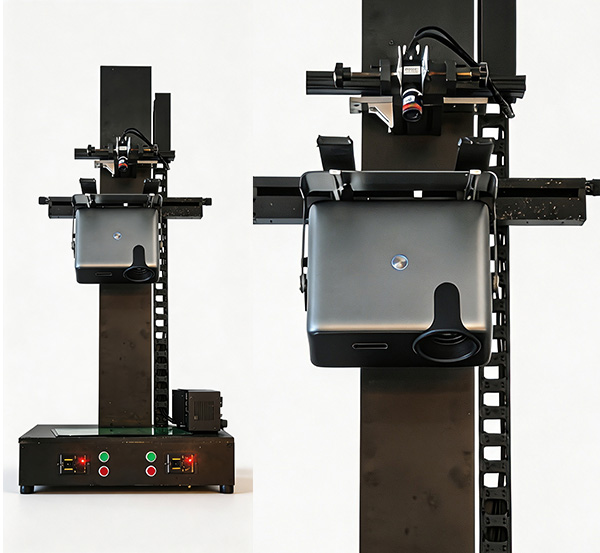
2. System Architecture: A Sense-Decide-Guide-Verify Loop
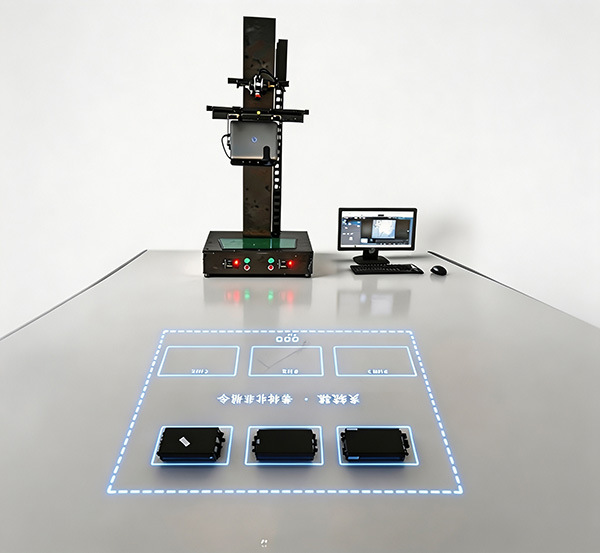
A high-precision industrial vision module and a high-brightness short-throw industrial projector are mounted directly above the workbench, forming a millisecond-level, four-step closed loop. Vision senses the state of the operator’s hands and the parts; algorithms decide whether the current step is compliant; the projector guides the operator on the tabletop; and vision verifies the outcome of the action. The mechanism rests on three key elements.
- Zero-peripheral, touch-free interaction. No holes need to be cut in the table for mechanical buttons or foot switches. The operator simply hovers a hand over a virtual “Start” key projected on the surface, and the vision algorithm detects it and starts the process, making start-up and confirmation fully contactless.
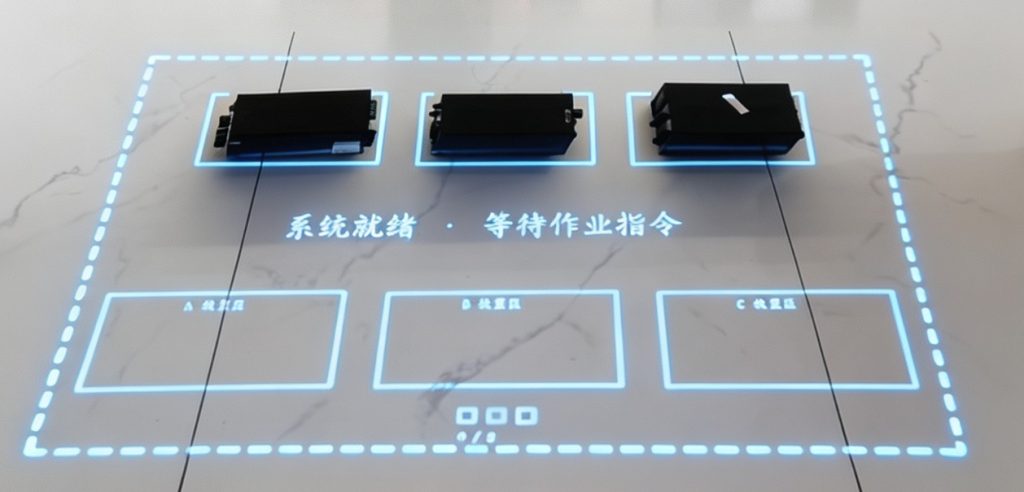
- 3D spatial calibration and mapping. Joint high-precision calibration of the camera, projector, and physical workstation coordinate systems achieves pixel-level alignment. Projected light accurately outlines each part’s physical footprint and its target assembly position, so that what is projected is exactly where it is. This is the foundation of the system’s accuracy and reliability.
- Dynamic path and flow guidance. Following the preset process, the system highlights the target part tray with a glowing ring and draws a flowing beam of light between the pick zone and the place zone. Operators know “what to pick and where to put it” at a glance, without having to think.
3. Core Strength: Two-Way, Strict Closed-Loop Error-Proofing
Unlike open-loop projection guidance that simply plays an animation, the core value of this system is real-time sensing and online verification of operator behavior by machine vision, which forms two lines of defense:
- Pick error-proofing (wrong pick, instant alarm). When the process calls for “Part B” but the operator’s hand reaches toward the adjacent “Part C,” the vision algorithm triggers interception the instant the hand enters a disallowed ROI (region of interest). The entire tabletop switches to a full-frame red warning frame, with a projected text alert identifying the wrong zone and directing the operator to return the part and pick the correct one.
- Place error-proofing (wrong placement, instant block). If the operator picks the correct part but tries to put it in a non-designated station (for example, moving Part C into Part B’s placement zone), the spatial position check blocks it in real time, again flashing red with precise corrective guidance. This removes the risk of mixed or misassembled parts at the source.
- Adaptive progress control. Only when the part has correctly left its original position and landed precisely in the target zone does the system judge the step as passed. The progress counter at the top (e.g., 1/3 → 2/3 → 3/3) increments automatically and unlocks the next step. When all steps are complete, a green check mark and a “Job Complete” message are projected on the table, and the system resets to standby.
As a result, error-proofing shifts from detection after the fact to guidance beforehand and interception in the moment: a non-conforming action cannot continue at the instant it occurs.
4. Advantages: Compared with Traditional Methods
| Dimension | Traditional Screens / Paper SOPs | Vision + Projection Poka-Yoke System |
| Line of sight & focus | Frequent glances up at a screen or paper; easy to get distracted or skip a step | Eyes stay on the parts, hands stay in place; the light cue is the focus of the action |
| Error-proofing level | Relies on operator discipline; after-the-fact inspection or sampling and rework | Guidance before, interception during; a non-conforming action cannot proceed |
| Changeover cost | Replace physical fixtures and stops, light curtains, or re-label | Software-only; redraw frames and recalibrate for the new product |
| New-hire learning curve | 3 to 7 days memorizing steps and part numbers | See and do; new hires meet standard on day one |
| Workstation tidiness | Dense sensors and tangled cabling | Overhead integrated mounting; flat tabletop with no exposed wiring |
From a lean manufacturing perspective, this approach addresses four dimensions at once: quality (error-proofing), efficiency (shorter training and changeover), human factors (less gaze switching and fatigue), and shop-floor management (5S tidiness). Changeover is where the contrast is sharpest. Traditional solutions require swapping physical fixtures, whereas this system only needs the frames to be redrawn and recalibrated in software to fit a new product, which suits the rhythm of high-mix, low-volume production well.
5. Typical Applications
- 3C electronics and back-end semiconductor assembly: Screw fastening of tiny components, ribbon cable insertion, and assembly of irregular structural parts, where human eyes tire easily and the cost of a miss is high.
- Automotive wire harness and component sorting: Pin error-proofing for multi-circuit connectors, instrument panel assembly, and manual assist stations for high-voltage battery modules.
- Medical device packaging and consumable kitting: Strict bill-of-materials (BOM) verification for surgical kits, and touch-free assembly in cleanrooms.
- High-mix, low-volume mixed-flow lines: Flexible lean production cells (cell lines) with frequent changeovers and a high share of manual stations.
6. Conclusion
Machine vision plus spatial projection is not simply a matter of “projecting work instructions onto a table.” It unifies guidance and verification: the projection tells people what to do, and vision confirms they did it correctly. The loop between the two embeds error-proofing in the operation itself, rather than relying on operator diligence and after-the-fact remedies. For discrete manufacturers pursuing zero defects, fast changeovers, and low training costs, this is a practical and repeatable path to smart upgrading. As calibration accuracy, vision algorithms, and projection brightness continue to improve, such systems are likely to expand from a single workstation to a standardized work layer covering entire flexible production lines.